> ## Documentation Index
> Fetch the complete documentation index at: https://docs.starfort.io/llms.txt
> Use this file to discover all available pages before exploring further.
# Register a Guardian
> Create a Guardian in a project: name it, choose Input Types, and pick a preset.
A [Guardian](/en/v1.2/concepts/guardian) is what inspects content in a project. Registering one creates a **Project Guardian** from a System Guardian preset.
## Create the Guardian
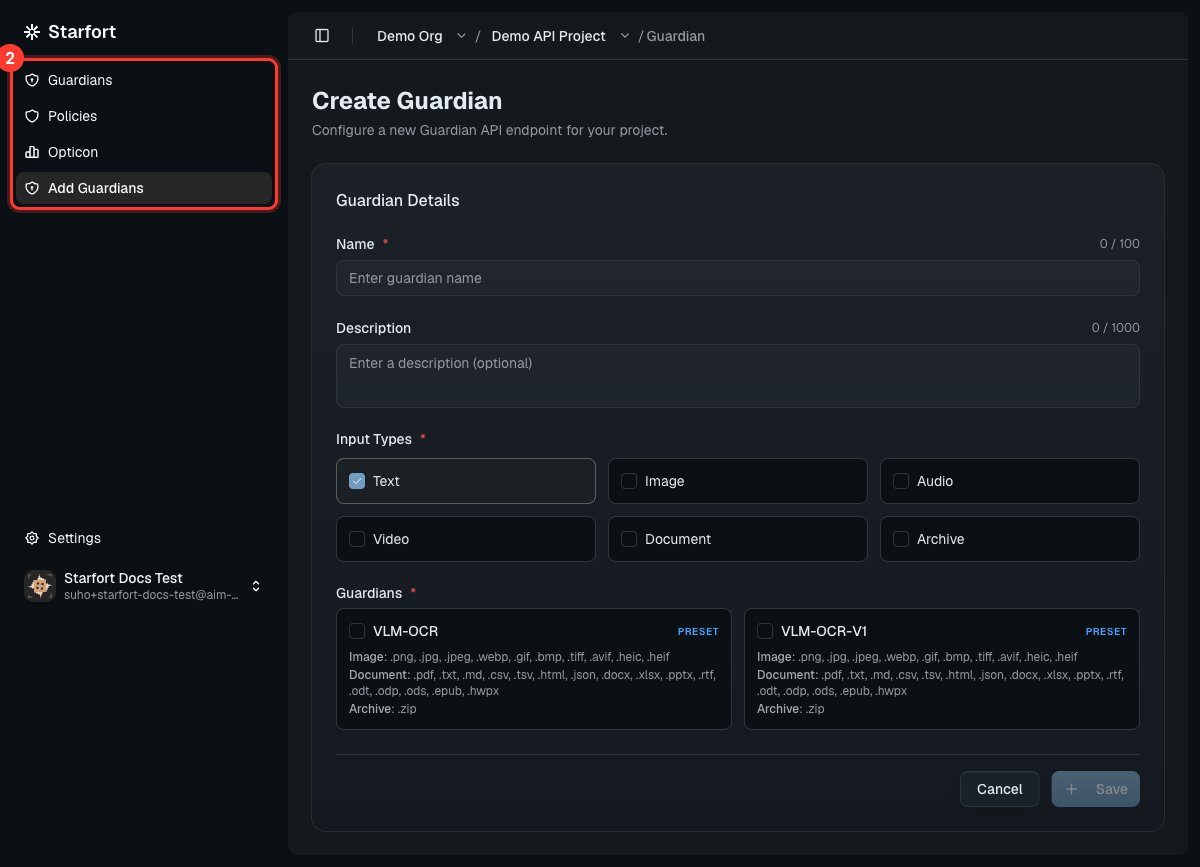
Registering one takes just **four required fields** — everything else is auto-filled from the chosen preset, and the Guardian is **active immediately** (no separate activation step). In the project, choose **Create Guardian** and fill in:
A name to identify this Guardian. The name must be **unique within the project** — it's used as the trace name in [Opticon](/en/v1.2/admin/monitoring-opticon).
Enable the content kinds it will inspect — Text, Image, Audio, Video, Document, Archive (at least one).
After selecting Input Types, pick a preset such as **VLM-OCR**. Only presets that support **all** of your chosen Input Types are shown. In a **Desktop Agent** project, only Desktop-Agent-compatible presets appear.
The Guardian is created and you're taken to its **How to use** page — ready to call once it has a key (API) and a policy.
 A project can have **several Guardians**, each on a different preset.
## After creation
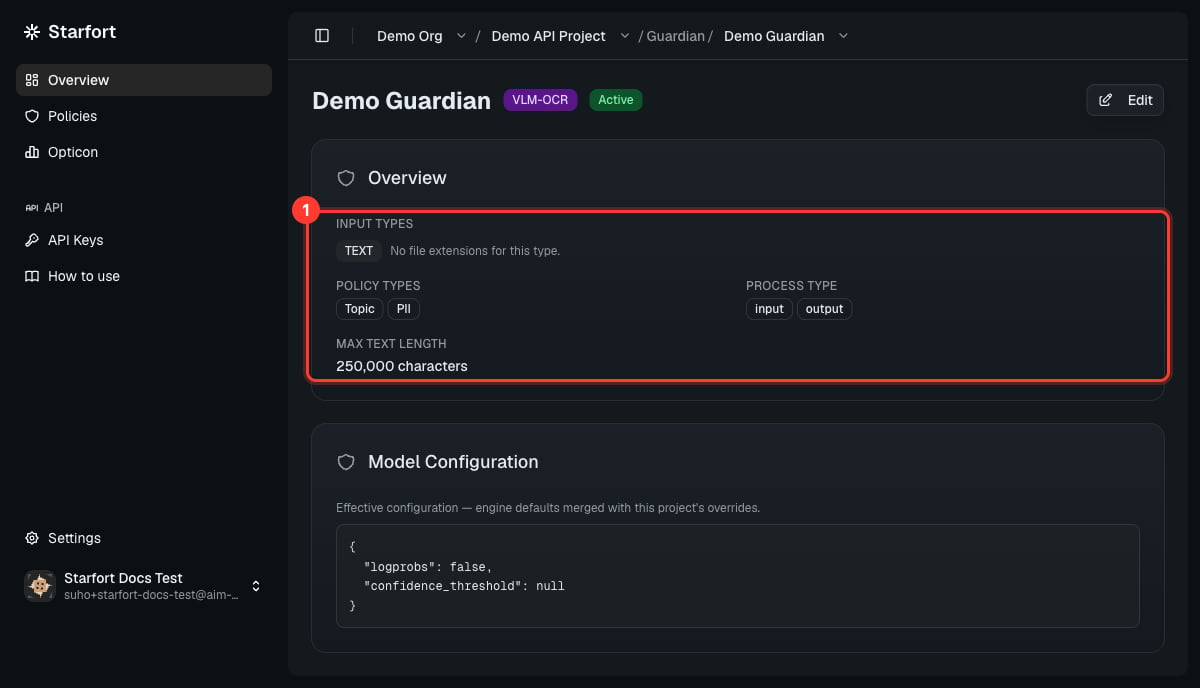
The Guardian's **Overview** shows its Input Types, supported **Policy Types** (PII, Topic), **process types** (`input`, `output`), text-length and file-size limits, and **Model Configuration**.
The preset's values are **copied into the Guardian at creation** — a snapshot you own. Later changes to the underlying preset don't reach back into your Guardian (only its endpoint binding keeps tracking the live service). You can override the copied limits, supported extensions, and Model Configuration in the Guardian's **Settings** within the preset's range, but the **set of supported Policy Types is inherited whole and isn't editable** here. Files in formats the Guardian doesn't support are **blocked** by default (you can switch this to pass in Settings).
In a **Desktop Agent** project, the Guardian also has a **Control Profile mapping** step: pick which Dynamic [Control Profiles](/en/v1.2/admin/control-profiles) this Guardian handles (each mapping has an on/off toggle, on by default). Unmapped targets are logged in Opticon but not sent to a Guardian.
A new Guardian has **no policies yet** — it won't mask or block anything until you [assign a Guard Policy](/en/v1.2/admin/author-guard-policy).
A project can have **several Guardians**, each on a different preset.
## After creation
The Guardian's **Overview** shows its Input Types, supported **Policy Types** (PII, Topic), **process types** (`input`, `output`), text-length and file-size limits, and **Model Configuration**.
The preset's values are **copied into the Guardian at creation** — a snapshot you own. Later changes to the underlying preset don't reach back into your Guardian (only its endpoint binding keeps tracking the live service). You can override the copied limits, supported extensions, and Model Configuration in the Guardian's **Settings** within the preset's range, but the **set of supported Policy Types is inherited whole and isn't editable** here. Files in formats the Guardian doesn't support are **blocked** by default (you can switch this to pass in Settings).
In a **Desktop Agent** project, the Guardian also has a **Control Profile mapping** step: pick which Dynamic [Control Profiles](/en/v1.2/admin/control-profiles) this Guardian handles (each mapping has an on/off toggle, on by default). Unmapped targets are logged in Opticon but not sent to a Guardian.
A new Guardian has **no policies yet** — it won't mask or block anything until you [assign a Guard Policy](/en/v1.2/admin/author-guard-policy).
 ## Next